Ahrefs vs BuzzSumo (2026) : fonctionnalités et prix
Ahrefs free plan; from ~$29/mo, BuzzSumo à partir de ~199 $/mois. Le coût réel pour une équipe. ViralHunt, $29/mois pour tous.
| Tool | Best for | Starting price | What that price covers | Free plan |
|---|---|---|---|---|
| Ahrefs | les équipes SEO qui recherchent mots-clés, backlinks et contenu le plus lié | free plan; from ~$29/mo | 1 user included | Free plan (limited) |
| BuzzSumo | les marketeurs qui recherchent les meilleurs articles et influenceurs par mot-clé | à partir de ~199 $/mois | 1 user, 2 alerts | Free trial |
| ViralHunt | discovering viral content and turning it into posts, as a team | from $29/mo | your whole team, no per-seat charge | Yes, and it never expires |
Every price was read off the vendor's own pricing page. We show no G2 or Capterra ratings because we are not listed there, and an invented rating would destroy the only thing these pages have, which is that all of it can be checked.
Vous hésitez entre Ahrefs et BuzzSumo ? Ci-dessous, nous les comparons fonctionnalité par fonctionnalité, sur les prix et les cas d'usage — et montrons où ViralHunt s'impose comme l'alternative tout-en-un qui suit le contenu viral sur 12 réseaux.
| Fonctionnalité | Ahrefs | BuzzSumo | ViralHunt |
|---|---|---|---|
| Réseaux sociaux couverts | Web / index de recherche | Web/articles + social limité | 12 — TikTok, Instagram, Facebook, Pinterest, Reddit, X, Bluesky, Mastodon, Douyin, RSS, Quora, Tumblr |
| Découverte de contenu viral en temps réel | Partiel | Partiel | ✓ |
| Suivi de l'engagement par post | Partiel | Partiel | ✓ |
| Radar de tendances multiplateforme | ✗ | ✗ | ✓ |
| Tableau éditorial (workflow Kanban) | ✗ | ✗ | ✓ |
| Studio de contenu IA | Partiel | Partiel | ✓ |
| Chat d'équipe intégré | ✗ | ✗ | ✓ |
| Extensions de navigateur (scrapers) | Partiel | ✗ | ✓ |
| Suivi de niche / mots-clés | ✓ | ✓ | ✓ |
| Écoute des mentions / du sentiment | ✗ | Partiel | Partiel |
| Planification et publication | Social Media Manager (beta) | ✗ | ✓ |
| Auto-DM (commentaire → DM) | ✗ | ✗ | ✓ |
| API publique + accès agents IA | ✓ | ✓ | ✓ |
| Essai gratuit | Free plan (limited) | ✓ | Free plan, no expiry |
| Prix de départ | free plan; from ~$29/mo | à partir de ~199 $/mois | à partir de 29 $/mois |
📡 12 réseaux, un seul écran
TikTok, Instagram, Facebook, Pinterest, Reddit, X, RSS, Quora et Tumblr — posts viraux et engagement dans un seul radar.
🗂️ Workflow intégré
Assignez n'importe quel post à un tableau éditorial, rédigez avec le studio IA et coordonnez via le chat d'équipe — sans outils supplémentaires.
💸 Meilleur rapport qualité-prix
Un seul abonnement abordable au lieu d'empiler un outil de découverte + un outil de workflow + un outil d'écoute.
Qu'est-ce que Ahrefs ?
Ahrefs est une suite SEO complète — backlinks, recherche de mots-clés, suivi de positions et audits — avec un Content Explorer qui cherche dans des milliards de pages par sujet pour révéler les articles les plus liés et partagés. Les marketeurs le comparent souvent à BuzzSumo pour la recherche de contenu. Mais Ahrefs tourne autour du SEO/recherche : il trouve les meilleures pages web et leurs backlinks, pas les posts viraux qui tournent en ce moment sur TikTok, Instagram ou Reddit, et sans workflow de contenu.
- Données de backlinks et de mots-clés de premier plan
- Le Content Explorer trouve les articles les plus partagés/liés
- Audits SEO poussés et suivi de positions
- Centré SEO/recherche — pas de découverte virale native
- Sans tableau éditorial ni workflow de contenu
- Cher ; sans radar viral par réseau
Tarifs: free plan; from ~$29/mo
Qu'est-ce que BuzzSumo ?
BuzzSumo est une plateforme de recherche et d'analyse de contenu. Vous cherchez dans une base de milliards d'articles par sujet pour trouver les contenus et titres les plus performants, découvrir des influenceurs, surveiller des concurrents et configurer des alertes. Ses Trending Feeds montrent les posts les plus partagés des dernières 24 heures. C'est fait pour les marketeurs qui recherchent des idées — pas pour suivre les posts viraux natifs sur les réseaux ni pour gérer une équipe de contenu.
- Énorme base d'articles et de titres à explorer
- Bonne découverte d'influenceurs et analyse de contenu
- Alertes configurables et surveillance des concurrents
- Centré sur les articles — suivi viral par réseau limité
- Sans workflow de contenu ni tableau d'équipe
- Prix élevé pour les petites équipes
Tarifs: à partir de ~199 $/mois
Qu'est-ce que ViralHunt ?
ViralHunt est une plateforme de découverte de contenu viral qui suit les posts les plus performants sur 12 réseaux — TikTok, Instagram, Facebook, Pinterest, Reddit, X, RSS, Quora et Tumblr — en temps réel. Au-delà de la découverte, elle transforme les tendances en workflow d'équipe avec un tableau éditorial Kanban, un studio de contenu IA et un chat intégré, pour qu'une équipe entière trouve, assigne et crée du contenu au même endroit.
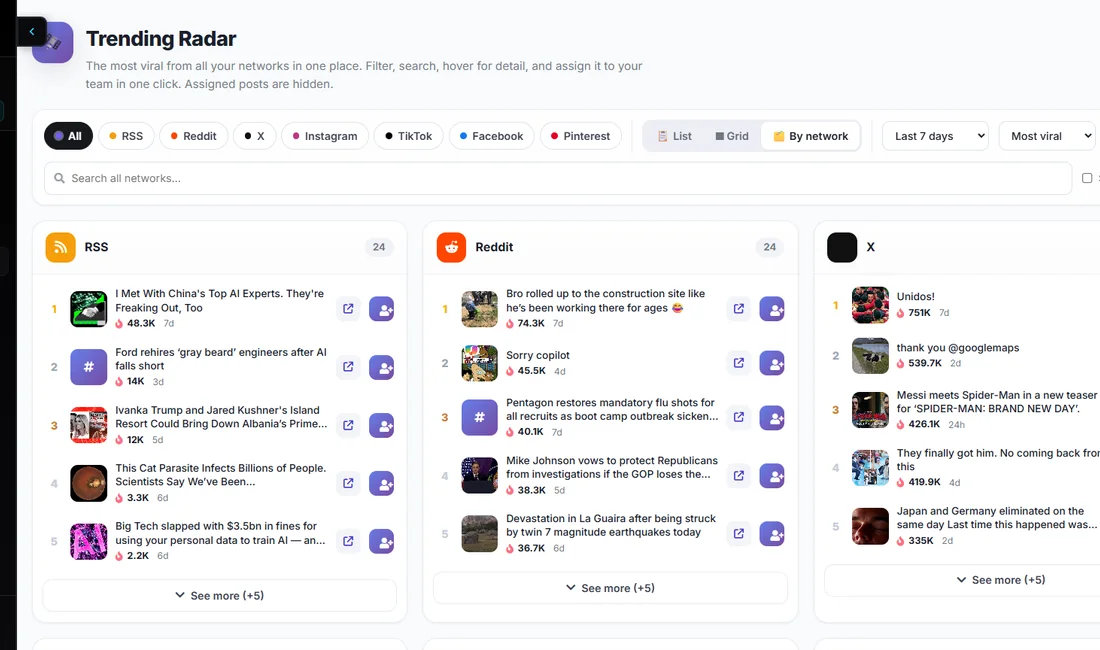
- Suit les posts viraux sur 12 réseaux dans un seul tableau de bord
- Tableau éditorial, studio IA et chat d'équipe intégrés — sans outils supplémentaires
- Radar de tendances multiplateforme + filtres de niche/mots-clés
- Abordable, avec essai gratuit
- Pas une suite de listening/analytique d'entreprise
- Marque plus jeune que les acteurs établis
Tarifs: à partir de 29 $/mois
When to buy one of these two
You came here comparing two tools, not looking for a third. So first, plainly, what each one is the better buy for:
- Ahrefs if your job is les équipes seo qui recherchent mots-clés, backlinks et contenu le plus lié. Données de backlinks et de mots-clés de premier plan.
- BuzzSumo if your job is les marketeurs qui recherchent les meilleurs articles et influenceurs par mot-clé. Énorme base d'articles et de titres à explorer.
If either of those sentences describes your job, you have your answer and the rest of this page is not for you. What follows is for the case where neither one does.
Vous comparez Ahrefs et BuzzSumo parce qu'aucune ne fait vraiment ce qu'il vous faut? ViralHunt a un plan gratuit qui n'expire pas: vérifier ne coûte rien et il n'y a pas de compte à rebours.
Essayer gratuitementThe short answer
BuzzSumo and Ahrefs get compared constantly, and the comparison is slightly unfair to both, because they index different things. BuzzSumo indexes what gets shared. Ahrefs indexes what gets linked. Almost every real decision between them comes down to which of those two signals your job depends on.
If you do PR, outreach or content research and you need to know which articles are being passed around right now, BuzzSumo answers that directly and Ahrefs only approximates it. If you need to know why a page ranks, who links to it and what to write to outrank it, Ahrefs answers that and BuzzSumo cannot.
Pick quickly
- Buy Ahrefs if the work is search: keywords, backlinks, rank tracking, technical audits. Nothing on this page is an argument against that.
- Buy BuzzSumo if the work is earned media: finding the articles and authors that travel, and the journalists who cover your space.
- Buy neither if what you need is the native post going viral on TikTok, Instagram or Reddit this afternoon. Both tools are built around web pages, which is the gap covered further down.
Links and shares are not the same signal, and the difference decides the tool
A link is a durable, editorial vote: someone published a page and chose to point at yours. It accumulates slowly, it decays slowly, and it moves search rankings. A share is a fast, disposable vote: someone pushed a story into a feed and thousands of people saw it for six hours. It moves attention, not rankings.
That is the whole architecture difference. Ahrefs crawls the web and stores the link graph, so its Content Explorer can tell you the most-linked page on a topic across years. BuzzSumo tracks engagement on URLs across social platforms, so it can tell you the most-shared article on a topic this week.
The practical consequence is that the two tools disagree, and both are right. Ask each for the top content on a topic: Ahrefs hands you the definitive guide published three years ago with 900 referring domains, BuzzSumo hands you the news story from Tuesday with 40,000 engagements. If you are writing a pillar page, the first list is the correct one. If you are pitching a journalist this week, the second one is.
What each one costs a team, which is not what the pricing page implies
Both headline prices describe a single user, and both get considerably more expensive the moment a second person needs to log in. Most comparisons stop before this point, and this is where the real difference in cost appears.
Ahrefs runs a free tier and a Starter plan at $29/mo, then Lite at $129, Standard at $249 and Advanced at $449. Every one of those includes exactly one user. Extra seats are $40/mo each on Lite, $60 on Standard, $80 on Advanced. Starter is single-user and heavily limited, so Lite is realistically the first plan a team can work on: five people comes to $129 plus four seats at $40, about $289/mo.
BuzzSumo starts at $199/mo for one user and two alerts. The first tier that admits five users is PR and Comms at $299/mo. For a team, BuzzSumo therefore closes some of the gap, because its higher tier is seat-inclusive while Ahrefs keeps charging per head.
Read both of those off the vendors own pricing pages before relying on them. Ahrefs added the $29 Starter plan without announcing it, and this site carried $129 as their entry price until that was caught and corrected.
For five people, as of 3 September 2026
- Ahrefs: about $289/mo, which is Lite plus four seats at $40 each.
- BuzzSumo: $299/mo, the PR and Comms tier, their first seat-inclusive plan.
- ViralHunt: $29/mo for the whole team, with a free plan that does not expire.
Where they genuinely overlap: Content Explorer against the BuzzSumo index
The overlap is narrower than the comparison implies and it lives in one feature. Ahrefs Content Explorer searches a large index of pages by topic and can sort by referring domains, organic traffic and social shares. That last sort is the reason these two tools end up in the same conversation at all.
The honest read is that Content Explorer is a very good secondary use of an index built for something else, and BuzzSumo is a primary tool for exactly that job. If content discovery is an occasional task inside an SEO workflow you already pay for, Content Explorer is probably enough and the marginal cost is zero. If content discovery is the job, then the daily alerting, the author and journalist data and the platform-level engagement breakdown are what you are paying BuzzSumo for, and Content Explorer does not replace them.
The reverse deserves saying just as plainly: BuzzSumo will not audit your site, will not tell you why you dropped three positions, and has no backlink data worth acting on. Nobody should buy BuzzSumo to do SEO.
What neither of them shows you
Both tools are built around the URL. A page gets published, it accumulates links or shares, and the tool reports on the page. That model covers the open web well, and it covers social platforms only as a referrer.
So the object most content teams actually chase is invisible to both: the native post. The Reddit thread with 40,000 upvotes that never links anywhere. The TikTok that put a product into three million feeds. The Instagram carousel a competitor posted this morning. None of those is a URL accruing backlinks, and none shows up as an article with a share count.
This is not a criticism of either tool, it is a description of what they were built for. But it is why a team can pay $289 or $299 a month and still not be able to answer the question that came up in the morning meeting, which is simply: what is working right now on the networks we publish to.
That gap is what ViralHunt was built for, and the honest framing is that it is a different tool rather than a cheaper one. We track the post rather than the page across TikTok, Instagram, Reddit, X, Facebook, Pinterest, Bluesky, Douyin, Quora, Tumblr and RSS, with the engagement each post is actually pulling, and an editorial board so the thing you find becomes something a named person is assigned to publish.
Where the numbers on this page come from
Every price here was read off the vendors own pricing page on 3 September 2026, and it is dated for a reason: two of the three price corrections this site has had to make came from a competitor changing pricing with no announcement. If you are reading months later, check the source before relying on it.
The feature comparisons describe what each tool documents publicly. Where a capability is partial we say partial rather than claiming it outright, and where a competitor does something we do not, that is stated too. Ahrefs backlink data has no equivalent here and we are not going to pretend otherwise.
The engagement figures in the radar below are ours, drawn from the corpus we measure continuously across every network we track. They are live rather than illustrative, which means they will not match this sentence tomorrow, and they are the one part of this page that no competitor can copy.
Ce qui génère réellement de l engagement en ce moment
Aucun des deux outils de cette page ne suit les publications natives. Voici donc ce qu ils ne peuvent pas vous montrer: une publication par réseau, classée par l engagement qu elle génère, lue directement dans le corpus que nous mesurons.
- RedditAdding a dash of customer service175.8K upvotes
- TikTokReplying to @sixevan6767676767 Should hood mr beast drop an album 👀🔥10.5M likes
- XWe’re engaged. Through both the happy times and the difficult ones, we’ve shared so many moments together, supporting each other every step 935.8K likes
- InstagramProud to be part of another incredible Esports World Cup. 🎮🏆 Congratulations to all the champions, players and teams who made this event so 8.7M likes
- FacebookUn episodio de Dr. House terminó ayudando a resolver un misterioso caso médico en la vida real.137.8K reactions
Généré le 2026-09-04 00:30 à partir des publications que nous suivons en continu. Actualisé par un cron et non à la main, ce qui explique qu il dira autre chose demain.
Les prix et fonctionnalités de cette page ont été relevés sur le site de chaque éditeur le 2026-09-03. Vérifiez-les vous-même: deux des trois corrections que nous avons dû faire venaient d un éditeur changeant ses prix sans préavis.
Lequel choisir ?
- Ahrefs — idéal pour les équipes SEO qui recherchent mots-clés, backlinks et contenu le plus lié.
- BuzzSumo — idéal pour les marketeurs qui recherchent les meilleurs articles et influenceurs par mot-clé.
- ViralHunt — idéal si vous voulez découvrir du contenu viral sur 12 réseaux et le transformer en contenu en équipe.
Questions fréquentes
Ahrefs ou BuzzSumo : lequel est le meilleur ?
Quelle est la meilleure alternative à Ahrefs ?
Combien coûtent Ahrefs et BuzzSumo ?
Découvrez ce qui devient viral dans votre niche en ce moment
Essayez ViralHunt gratuitement dès aujourd'hui.
Essayer gratuitement