Research articles and topics
BuzzSumo includes Content Analyzer, Trending Feeds and a Chrome extension. Its Content Creation price of $199/month is billed annually.
BuzzSumo $199/mo billed annually, Ahrefs free plan; from ~$29/mo, checked by hand in 2026. Where each one wins, what a team of five really pays, and the cases where neither is the right buy.
Comparing BuzzSumo alternatives? Start with your main task, then compare the plan you actually need.
Start with a topic you know, inspect the available posts, then organize your research. Decide whether the results fit your work before upgrading.
This comparison is published by ViralHunt. These tools overlap, but are not interchangeable. Check billing periods, seats and feature limits at the sources.
BuzzSumo · AhrefsPrices and features read off each vendor page on 2026-09-03.
| Tool | Best for | Starting price | What that price covers | Free plan |
|---|---|---|---|---|
| BuzzSumo | marketers researching top articles and influencers by keyword | $199/mo billed annually | 1 user, 2 alerts | Free trial |
| Ahrefs | SEO teams researching keywords, backlinks and top-linked content | free plan; from ~$29/mo | 1 user included | Free plan (limited) |
| ViralHunt | discovering viral content and turning it into posts, as a team | from $29/mo | 1 user (Creator). Studio: $99/mo for up to 4 users and 4 projects, no per-seat charge | Yes, and it never expires |
Every price was read off the vendor's own pricing page. We show no G2 or Capterra ratings because we are not listed there, and an invented rating would destroy the only thing these pages have, which is that all of it can be checked.
Choosing between BuzzSumo and Ahrefs? Below we break them down feature by feature, on pricing and on use case, and show where ViralHunt fits as the all-in-one alternative that tracks viral content across 12 networks.
| Feature | BuzzSumo | Ahrefs | ViralHunt |
|---|---|---|---|
| Social platforms covered | Web/articles + limited social | Web / search index | 12, TikTok, Instagram, Facebook, Pinterest, Reddit, X, Bluesky, Mastodon, Douyin, RSS, Quora, Tumblr |
| Real-time viral content discovery | Partial | Partial | ✓ |
| Per-post engagement tracking | Partial | Partial | ✓ |
| Cross-platform trending radar | Partial | ✗ | ✓ |
| Editorial board (Kanban workflow) | ✗ | ✗ | ✓ |
| AI content studio | Partial | Partial | ✓ |
| Built-in team chat | ✗ | ✗ | ✓ |
| Browser-extension scrapers | Partial | Partial | ✓ |
| Niche / keyword tracking | ✓ | ✓ | ✓ |
| Mention / sentiment listening | Partial | ✗ | Partial |
| Post scheduling & publishing | ✗ | Social Media Manager (beta) | ✓ |
| Auto-DM (comment → DM) | ✗ | ✗ | ✓ |
| Public API + AI-agent access | ✓ | ✓ | ✓ |
| Free trial | ✓ | Free plan (limited) | Free plan, no expiry |
| Starting price | $199/mo billed annually | free plan; from ~$29/mo | from $29/mo |
| BuzzSumo | Ahrefs | ViralHunt | |
|---|---|---|---|
| One person | $199/mo (annual)1 user, 2 alerts | $129/mo1 user included | $29/mo1 user, 1 project (Creator). Free plan that never expires. |
| Team of five | $299/mo (annual)the PR & Comms tier, the first that allows 5 users | $489/moStandard $249 plus 4 extra users at $60/mo; Lite allows only 2 extra users | $199/moAgency: up to 10 users and 10 brands. Studio is limited to 4 users. |
Read off each vendor pricing page on 2026-09-02. Check them yourself: two of the three corrections we have made were in our own favour.
TikTok, Instagram, Facebook, Pinterest, Reddit, X, Bluesky, Douyin, RSS, Quora & Tumblr, viral posts and engagement in a single radar.
Assign any post to an editorial board, draft with the AI studio, and coordinate in team chat, no extra tools.
One affordable plan instead of stacking a discovery tool + a workflow tool + a listening tool.
BuzzSumo is a content research and analysis platform. You search a database of billions of articles by topic to find the best-performing content and headlines, discover influencers, monitor competitors and set up alerts. Its Trending Feeds surface the most-shared posts of the last 24 hours. It is built for content marketers researching ideas, not for tracking native viral posts across social networks or running a content team.
Pricing: $199/mo billed annually
Ahrefs is a full SEO toolset, backlinks, keyword research, rank tracking and site audits, with a Content Explorer that searches billions of pages by topic to surface the most-linked and most-shared articles. Marketers often weigh it against BuzzSumo for content research. But Ahrefs is built around search/SEO: it finds top web pages and their backlinks, not the native viral posts running on TikTok, Instagram or Reddit right now, and it has no content workflow.
Pricing: free plan; from ~$29/mo
You came here comparing two tools, not looking for a third. So first, plainly, what each one is the better buy for:
If either of those sentences describes your job, you have your answer and the rest of this page is not for you. What follows is for the case where neither one does.
ViralHunt is a viral-content discovery platform that tracks the top-performing posts across 12 networks, TikTok, Instagram, Facebook, Pinterest, Reddit, X, Bluesky, Mastodon, Douyin, RSS, Quora and Tumblr, in real time. Beyond discovery, it turns trends into a team workflow with an editorial Kanban board, an AI content studio and built-in team chat, and now schedules and auto-publishes finished posts to 11 social networks, with separate brand/client projects. So a whole team can find, create and publish content in one place instead of stacking a discovery tool, a workflow tool and a scheduler.
Pricing: from $29/mo
Comparing BuzzSumo and Ahrefs because neither one quite does what you need? ViralHunt has a free plan that does not expire, so checking is free and there is no countdown.
Try for freeBuzzSumo and Ahrefs get compared constantly, and the comparison is slightly unfair to both, because they index different things. BuzzSumo indexes what gets shared. Ahrefs indexes what gets linked. Almost every real decision between them comes down to which of those two signals your job depends on.
If you do PR, outreach or content research and you need to know which articles are being passed around right now, BuzzSumo answers that directly and Ahrefs only approximates it. If you need to know why a page ranks, who links to it and what to write to outrank it, Ahrefs answers that and BuzzSumo cannot.
A link is a durable, editorial vote: someone published a page and chose to point at yours. It accumulates slowly, it decays slowly, and it moves search rankings. A share is a fast, disposable vote: someone pushed a story into a feed and thousands of people saw it for six hours. It moves attention, not rankings.
That is the whole architecture difference. Ahrefs crawls the web and stores the link graph, so its Content Explorer can tell you the most-linked page on a topic across years. BuzzSumo tracks engagement on URLs across social platforms, so it can tell you the most-shared article on a topic this week.
The practical consequence is that the two tools disagree, and both are right. Ask each for the top content on a topic: Ahrefs hands you the definitive guide published three years ago with 900 referring domains, BuzzSumo hands you the news story from Tuesday with 40,000 engagements. If you are writing a pillar page, the first list is the correct one. If you are pitching a journalist this week, the second one is.
Both headline prices describe a single user, and both get considerably more expensive the moment a second person needs to log in. Most comparisons stop before this point, and this is where the real difference in cost appears.
Ahrefs runs a free tier and a Starter plan at $29/mo, then Lite at $129, Standard at $249 and Advanced at $449. Every one of those includes exactly one user. Extra seats are $40/mo each on Lite, $60 on Standard, $80 on Advanced. Lite allows only two extra users. A five-person team can use Standard at $249 plus four users at $60 each: $489/mo.
BuzzSumo starts at $199/mo for one user and two alerts. The first tier that admits five users is PR and Comms at $299/mo. For a team, BuzzSumo therefore closes some of the gap, because its higher tier is seat-inclusive while Ahrefs keeps charging per head.
Read both of those off the vendors own pricing pages before relying on them. Ahrefs added the $29 Starter plan without announcing it, and this site carried $129 as their entry price until that was caught and corrected.
The overlap is narrower than the comparison implies and it lives in one feature. Ahrefs Content Explorer searches a large index of pages by topic and can sort by referring domains, organic traffic and social shares. That last sort is the reason these two tools end up in the same conversation at all.
The honest read is that Content Explorer is a very good secondary use of an index built for something else, and BuzzSumo is a primary tool for exactly that job. If content discovery is an occasional task inside an SEO workflow you already pay for, Content Explorer is probably enough and the marginal cost is zero. If content discovery is the job, then the daily alerting, the author and journalist data and the platform-level engagement breakdown are what you are paying BuzzSumo for, and Content Explorer does not replace them.
The reverse deserves saying just as plainly: BuzzSumo will not audit your site, will not tell you why you dropped three positions, and has no backlink data worth acting on. Nobody should buy BuzzSumo to do SEO.
Both tools are built around the URL. A page gets published, it accumulates links or shares, and the tool reports on the page. That model covers the open web well, and it covers social platforms only as a referrer.
So the object most content teams actually chase is invisible to both: the native post. The Reddit thread with 40,000 upvotes that never links anywhere. The TikTok that put a product into three million feeds. The Instagram carousel a competitor posted this morning. None of those is a URL accruing backlinks, and none shows up as an article with a share count.
This is not a criticism of either tool, it is a description of what they were built for. But it is why a team can pay $489 monthly or $299 per month billed annually and still not be able to answer the question that came up in the morning meeting, which is simply: what is working right now on the networks we publish to.
That gap is what ViralHunt was built for, and the honest framing is that it is a different tool rather than a cheaper one. We track the post rather than the page across TikTok, Instagram, Reddit, X, Facebook, Pinterest, Bluesky, Douyin, Quora, Tumblr and RSS, with the engagement each post is actually pulling, and an editorial board so the thing you find becomes something a named person is assigned to publish.
Every price here was read off the vendors own pricing page on 3 September 2026, and it is dated for a reason: two of the three price corrections this site has had to make came from a competitor changing pricing with no announcement. If you are reading months later, check the source before relying on it.
The feature comparisons describe what each tool documents publicly. Where a capability is partial we say partial rather than claiming it outright, and where a competitor does something we do not, that is stated too. Ahrefs backlink data has no equivalent here and we are not going to pretend otherwise.
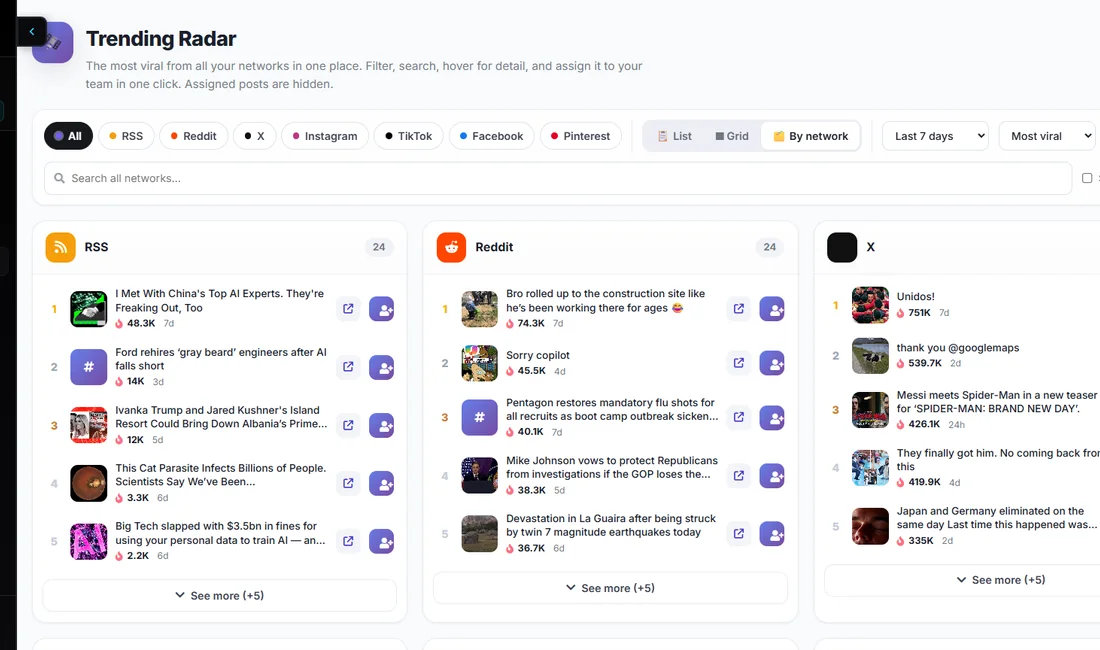
The engagement figures in the radar below are ours, drawn from the corpus we measure continuously across every network we track. They are live rather than illustrative, which means they will not match this sentence tomorrow, and they are the one part of this page that no competitor can copy.
Neither tool on this page tracks native posts, so here is the thing they cannot show you: one post per network, ranked by the engagement it is pulling, read straight off the corpus we measure.
Built 2026-10-19 22:00 from posts we track continuously. Refreshed by cron rather than written by hand, which is why it will say something different tomorrow.
Independent reviews and official walkthroughs on YouTube. We did not make these, do not endorse them, and they show the products in use.
Prices and features on this page were read off each vendor pricing page on 2026-09-03. Check them yourself: two of the three corrections we have had to make came from a vendor changing pricing with no announcement.